
The Heritage of Traditional Weaving Techniques: A Guide to Handmade Artistry
A masterfully crafted rug is not merely a floor covering; it is a silent, woven dialogue between an artisan and the passage of time. You likely appreciate the profound beauty of a hand-knotted piece, yet the complexity of distinguishing a true Persian knot from a Turkish one can feel overwhelming. Choosing between authentic silk and synthetic blends requires a discerning eye that many fear they lack, especially when making a significant investment for a sanctuary as personal as your home.
We understand that your space is a gallery of expression, where every object should reflect a standard of excellence. This guide will empower you with the knowledge to identify the subtle nuances of traditional weaving technique rugs, ensuring your next acquisition is a genuine masterpiece of heritage. We will explore the meticulous labor behind every knot, the sensory distinction of premium materials, and how these artistry-driven pieces serve as legacy assets for generations to come. From the technical mastery of the loom to the aesthetic soul of the design, you will gain the confidence to select a piece that truly belongs in a refined UAE residence.
Key Takeaways
- Uncover the profound human history behind each piece and why handmade artistry serves as a bridge between ancient traditions and your modern UAE home.
- Master the technical distinctions of traditional weaving technique rugs, including the structural secrets of Persian and Turkish knotting methods.
- Identify the superior luster and long-term durability provided by premium materials such as authentic Persian silk and highland wool.
- Learn how to transform your living space into a gallery of personal expression by selecting a rug that functions as a timeless legacy asset.
- Understand the importance of experiencing a rug's texture and color within your own sanctuary through a professional national home trial.
The Living History of Traditional Weaving Techniques
To truly appreciate the soul of a luxury masterpiece, one must first understand the journey of the loom. It began as a portable necessity for nomadic tribes, a tool for survival against desert winds and mountain chills. Over centuries, this humble craft migrated into the grand courts of kings, evolving from a functional utility into palace-grade artistry. Today, traditional weaving is a deliberate, rhythmic dialogue between the artisan and the raw material.
Machine-made rugs are products of code and steel. They possess a sterile perfection that lacks life. In contrast, handmade pieces carry a human connection that resonates within a private sanctuary. Every motif in a traditional Oriental rug carries a spiritual weight. A floral vine is rarely just decoration; it often serves as a prayer for prosperity. A geometric star can be a map of the heavens or a symbol of protection. These patterns are a silent language, spoken across cultures and centuries, connecting the modern UAE home to an ancient world of craftsmanship.
The Artisan’s Legacy
Master weavers don't learn their craft from manuals. They master the traditional loom through years of silent observation and dedicated apprenticeship. It's common for these skills to be passed down through generations, where the secrets of a specific village's knot or a family's dye recipe are treated as sacred inheritances. This lineage ensures that traditional weaving technique rugs maintain a standard of excellence that mass production can't touch. The weaver acts as a storyteller, embedding the history of their people into every rhythmic movement of the thread and dye.
Artistry vs. Mass Production
In the world of high-end design, uniformity is often the enemy of character. Mass production values identical results, but luxury artistry celebrates the "abrash." This term refers to the subtle, painterly variations in color that occur when natural dyes are used. These shifts in tone prove authenticity and give the rug a unique, one-of-a-kind depth that machines cannot replicate. Beyond the aesthetic, the structural differences are profound. Hand-bound edges and hand-knotted foundations provide a level of durability that machine-stitched seams simply cannot offer. While a factory-made piece is a temporary purchase, a handmade masterwork is a gallery piece for your floor, designed to endure as a legacy for your family.
Persian and Turkish Knotting: The Architecture of Artistry
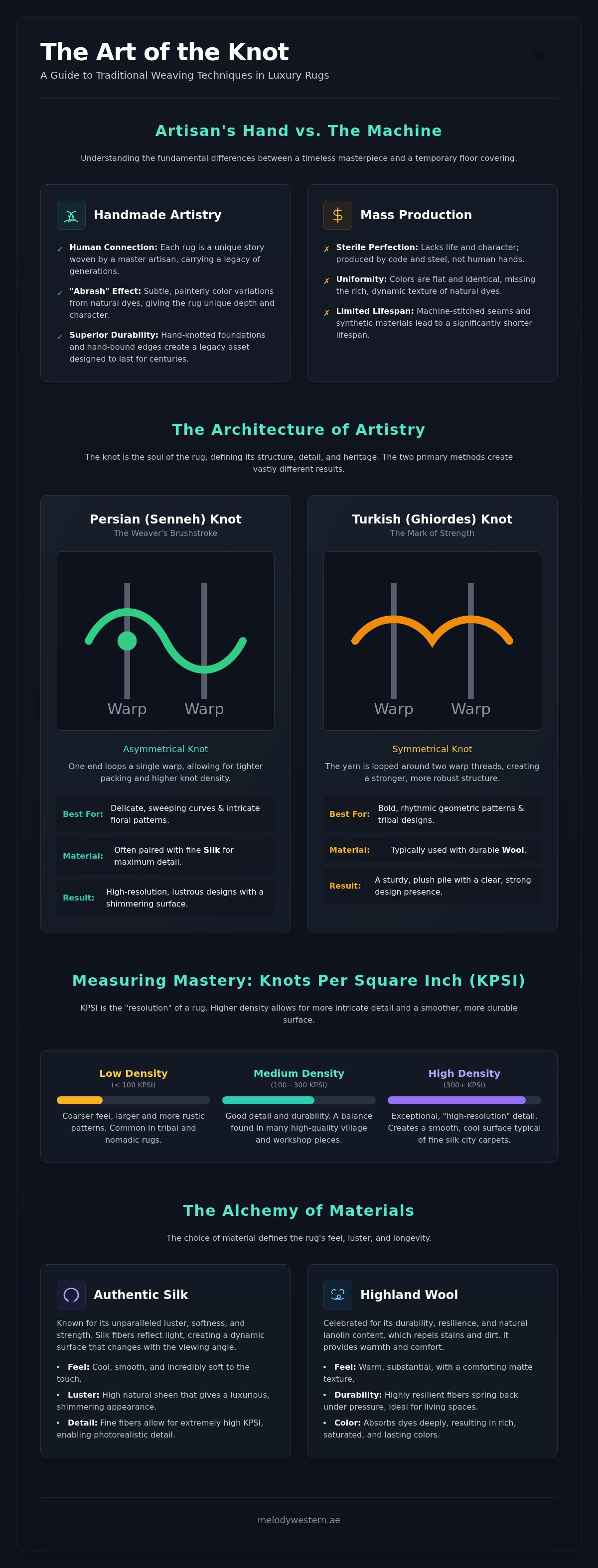
The knot is the invisible soul of a rug. It defines both the structural integrity and the aesthetic limits of the design. When exploring traditional weaving technique rugs, the choice between the Persian and Turkish knot represents a fundamental fork in the road of artistry. These methods are the building blocks of a history of oriental carpet-weaving that spans millennia, dictating whether a piece will feature the fluid curves of a garden or the bold, rhythmic strength of a mountain tribe.
Clarity and value are often measured by knot density, known as Knots Per Square Inch (KPSI). A high KPSI acts like a high-resolution screen; it allows for more intricate detail and a smoother transition between colors. In a masterwork, this density can reach hundreds of knots per inch. The tactile difference is profound. A high-density silk weave offers a cool, shimmering surface that reflects light differently from every angle. A standard wool knot provides a warm, matte comfort that absorbs sound and grounds a room. Understanding this architecture allows you to select a piece that complements the specific sensory requirements of your personal sanctuary.
The Senneh Knot and Persian Silk
The Senneh knot is asymmetrical. One end of the thread loops around a single warp, while the other remains free. This lack of symmetry allows the weaver to place knots closer together, creating the delicate, sweeping curves found in classic Persian carpets. When working with fine silk, this technique is essential. The thinness of the silk allows for an incredibly high knot count, resulting in a piece with unparalleled luster and detail. To verify this handmade authenticity, you should examine the back of the rug; the individual knots will appear slightly irregular, a hallmark of the artisan’s hand. If you wish to feel the distinction between these masterworks, you may explore our collection of Hand Made Rugs in the comfort of your own home.
The Ghiordes Knot and Tribal Heritage
Contrast this with the Ghiordes knot, a symmetrical double-knot that wraps around two warps. It is the definition of structural integrity. This method is traditionally favored for geometric motifs and tribal designs where strength and durability are paramount. Turkish techniques often utilize thicker highland wool, producing a robust texture that feels substantial underfoot. In the grand entrance of a villa, a rug woven with the Ghiordes knot makes a powerful statement of heritage and permanence. The double-knot creates a pile that stands upright, resisting the wear of high-traffic areas while maintaining its geometric clarity for decades. This traditional weaving technique rugs approach ensures that the piece remains a stable foundation for your home’s aesthetic for generations.
Beyond the Knot: Flat-Weaves and Hand-Tufting
While the intricate knot is often the focal point of heritage, the world of traditional weaving technique rugs extends into sophisticated textures that forgo the pile entirely. Flat-weaves, such as the Kilim and Soumak, represent a different philosophical approach to design. In these pieces, the pattern is created by the intersection of the warp and weft alone. This creates a textile that is lighter, more breathable, and perfectly suited for a minimalist sanctuary or a transitional space within a modern UAE villa. For those who view their floor as an extension of a gallery, the Frame Rug serves as the ultimate expression of this craft, elevating woven art from the floor to a prominent position as wall-mounted decor.
The Versatility of Flat-Woven Art
The absence of a pile creates a distinct sensory experience. Kilims offer a crisp, geometric clarity that feels contemporary yet ancient. Soumak weaving, which involves wrapping the yarn around the warp threads, provides a more complex, embroidered texture. This technique is exceptionally durable, making it an ideal choice for high-traffic luxury hallways where resilience must match aesthetic prestige. These methods share a common lineage with American handmade rug techniques and other global traditions that prioritize the human element over mass production. In a climate like ours, these lighter textiles provide a sense of cool refinement without sacrificing the warmth of an artisan's touch.
Hand-Tufted Luxury
Hand-tufting serves as a modern bridge between traditional artisan skill and contemporary design. Unlike the painstaking process of tying individual knots, a master artisan uses a specialized tufting gun to follow a meticulously designed pattern on a canvas backing. This allows for a plush, dense feel that is difficult to achieve with other methods. Hand-tufted rugs are often the preferred choice for private retreats and bedrooms where comfort is the primary objective. While a hand-knotted masterwork remains the ultimate legacy asset, a hand-tufted piece offers a sophisticated alternative for those seeking a specific density and a more immediate sense of luxury. It's a testament to how traditional weaving technique rugs continue to evolve, blending heritage with modern sensibilities to create a sanctuary of comfort.
The Alchemy of Materials: Silk, Wool, and the Artisan’s Hand
The raw fibers chosen for a masterwork dictate its destiny. This is an alchemy where nature's finest materials meet the artisan's patient hand, transforming raw thread into a legacy asset. While the knotting technique provides the structure, the material provides the soul. The selection of these fibers is what ultimately separates museum-quality traditional weaving technique rugs from those intended for temporary use. Every thread is a deliberate choice, intended to balance tactile comfort with long-term investment value.
The Prestige of Pure Silk
Persian silk remains the undisputed gold standard for luster and detail. Its unique molecular structure allows it to reflect light in a way that creates a captivating two-toned effect; a rug may appear deep and saturated from one side, only to shimmer with a silvery brilliance when viewed from the opposite angle. Beyond its beauty, silk possesses incredible tensile strength. This allows weavers to achieve microscopic knot precision that would be impossible with coarser fibers. Silk serves as the ultimate medium for bespoke luxury rugs because its unparalleled fine diameter allows master artisans to translate the most complex, personal visions into tangible, shimmering reality. For those seeking the pinnacle of this craft, you may view our exclusive collection of Persian Silk Rugs to find a piece that resonates with your aesthetic.
Artisan Dyeing Techniques
Color in a traditional rug is never static. Achieving the perfect hue requires a level of patience that modern manufacturing cannot comprehend. Traditional fermentation and dyeing processes can take weeks, using natural mordants to ensure the pigments bind permanently to the fiber. Unlike synthetic dyes that can appear flat or fade harshly, natural vegetable dyes age with a graceful patina. They develop a depth over decades that actually increases the rug's visual appeal. This process is also responsible for "abrash," the subtle, intentional color variations that occur when different batches of hand-dyed wool are used. These shifts in tone are not flaws. They are the fingerprints of the artisan, proving that the piece was created by a human hand rather than a machine.
Highland wool remains the foundation of traditional durability. Harvested from sheep living in high altitudes, this wool is rich in lanolin, making it naturally stain-resistant and incredibly resilient. When artisans blend this robust wool with silk, they create a textural masterpiece. The wool provides a matte, grounding foundation while the silk highlights dance across the surface, adding three-dimensional depth. This combination ensures that traditional weaving technique rugs are not just visual delights but tactile experiences that serve as significant investments in your lifestyle.
Selecting Your Legacy: Bringing Masterwork into the Modern Sanctuary
Selecting the right piece requires more than an appreciation for aesthetics; it requires an understanding of how a masterwork interacts with your daily life. A private study might call for the dense, sound-absorbing qualities of wool-based traditional weaving technique rugs, whereas a grand majlis demands the shimmering presence of a high-knot-count Persian silk piece. Every room in your residence possesses a unique light and purpose. The rug you choose must act as the anchor that harmonizes these elements, turning a house into a sanctuary of personal expression and prestige.
The Home Trial Experience
Witnessing a rug's soul in your own sanctuary is a non-negotiable step in the luxury selection process. The way natural light filters through your windows in Dubai or Abu Dhabi will transform the appearance of a weave compared to a showroom setting. Evaluating the scale and texture against your specific interior finishes ensures that the piece truly belongs. Melody Carpet facilitates this intimate experience by offering a free home trial nationally across the UAE, allowing you to live with the artistry before making it a permanent part of your legacy. It's a methodical approach that prioritizes your comfort and confidence, treating each acquisition as a significant life event.
Investing in Bespoke Craft
For those whose vision transcends an existing collection, commissioning a Custom Rug is the ultimate expression of personal refinement. This journey begins with a design concept and travels to the master artisan's loom, where the integrity of traditional knots is preserved in a piece designed for your estate's specific dimensions. A commissioned work is not merely a purchase; it's a contribution to the continuation of heritage. Whether you choose a Classic Carpet for the floor or a Modern Carpet to bridge the gap between ancient skill and contemporary architecture, you are investing in a masterwork that will endure for generations.
The transition from floor covering to wall-mounted art is a hallmark of the most curated spaces. A Frame Rug allows the intricate detail of traditional weaving technique rugs to be appreciated at eye level, highlighting the microscopic precision of the artisan's hand. In this context, the rug becomes a textile painting, a focal point that commands attention and invites deeper contemplation of its history. This elevated use of weaving demonstrates a deep respect for the craft, treating the rug as a legacy asset that holds its value through the sheer labor and history embedded in its fibers. By choosing a piece that honors these centuries-old methods, you ensure your home remains a gallery of timeless excellence.
Inviting Heritage into Your Private Sanctuary
A master-artisan rug is more than a design choice; it's a commitment to preserving a centuries-old dialogue between heritage and the home. By understanding the structural secrets of Persian and Turkish knots, and the sensory brilliance of premium silk and wool, you've gained the clarity needed to select a true legacy asset. These traditional weaving technique rugs don't just decorate a floor; they anchor your estate with a sense of permanence and prestige that mass production can never replicate.
The journey to finding the perfect centerpiece is a methodical one that deserves patience and expert guidance. We invite you to experience the artistry of our curated handmade collection with a complimentary home trial. With master artisan craftsmanship at the heart of every piece and the convenience of national UAE delivery, you can witness the soul of these weaves within your own light. Transform your residence into a gallery of personal expression where every step is a reminder of timeless excellence.
Expert Guidance on Traditional Weaving Techniques
What is the most durable traditional weaving technique for high-traffic areas?
The hand-knotted Ghiordes technique is widely considered the most durable choice for high-traffic areas. This symmetrical double-knot provides exceptional structural integrity by wrapping the yarn around two warp threads. When combined with lanolin-rich highland wool, the resulting rug resists crushing and maintains its pile height for decades. It's a stable foundation for busy hallways or entryways where resilience must match aesthetic prestige.
How can I tell if a rug is truly hand-knotted or just hand-tufted?
You can identify a truly hand-knotted piece by examining the back of the rug. In a hand-knotted masterwork, the individual knots are visible and slightly irregular, mirroring the pattern on the front. Hand-tufted rugs, however, always feature a canvas or cloth backing that hides the construction. The fringe on a hand-knotted rug is an extension of the foundation itself, while on a tufted piece, it's usually sewn on as a separate trim.
Why are Persian silk rugs considered a better investment than wool rugs?
Persian silk rugs are often viewed as superior investments due to their incredible knot density and the rarity of the material. A silk rug can feature over 1,000 knots per square inch, allowing for a level of detail that wool cannot achieve. This microscopic precision, combined with the natural luster of the fiber, ensures these pieces appreciate in value as museum-quality artifacts. They represent the pinnacle of traditional weaving technique rugs as legacy assets.
What does 'knot count' really mean for the quality of a handmade rug?
Knot count, or Knots Per Square Inch (KPSI), serves as the "resolution" of a handmade rug. A higher count indicates that more labor was required to create the piece, as the weaver must use finer threads and tie smaller knots. This density directly influences the clarity of the design and the rug's overall value. While a tribal rug might have 80 KPSI, a palace-grade silk piece can exceed 600, reflecting years of master-artisan dedication.
How do I care for a rug made with traditional vegetable dyes?
Caring for rugs colored with traditional vegetable dyes requires a gentle touch. You should avoid harsh chemical cleaners that can strip the natural pigments or cause colors to bleed. Rotating the rug every six months is essential to ensure any light exposure is even, as natural dyes develop a beautiful patina over time. For deep cleaning, always consult a specialist who understands the chemistry of organic mordants and pH-balanced solutions.
Can a traditional weaving technique be used for a modern, minimalist design?
Traditional weaving techniques are perfectly suited for modern, minimalist sanctuaries. Many contemporary designs utilize the flat-woven Kilim or Soumak methods to achieve clean, geometric lines without the weight of a heavy pile. By commissioning a custom rug, you can specify a minimalist palette while still benefiting from the structural excellence and human soul of ancient knotting methods. This blend of old-world skill and new-world aesthetic creates a unique gallery piece for your floor.
What is the difference between a Senneh knot and a Ghiordes knot?
The primary difference lies in the symmetry of the knot around the warp threads. The Senneh knot is asymmetrical, wrapping around one warp and looping under the next, which allows for fluid, floral curves. The Ghiordes knot is symmetrical, wrapping around two warps to create a robust, double-locked foundation. While the Senneh knot excels in intricate detail, the Ghiordes knot is prized for its strength in tribal and geometric designs.
How long does it typically take a master artisan to weave a luxury silk rug?
A master artisan may spend anywhere from six months to several years weaving a single luxury silk rug. The exact timeline depends on the size and the knot density. A standard 2x3 meter silk rug with a high KPSI involves millions of individual hand-tied knots. This slow, methodical pace is a testament to the artisan's patience and explains why these pieces are treated as significant investments in lifestyle and heritage.
Leave a comment