
Handmade Rug vs Machine Made: The Connoisseur’s Guide to Quality in 2026
The most exquisite sanctuaries aren't merely decorated; they're curated with objects that carry the breath of history and the touch of a master’s hand. You likely seek a piece that transcends simple decor, yet the fear of paying a master-artisan price for an industrial imitation is a valid concern for many collectors across the Emirates. Understanding the nuances of a handmade rug vs machine made is no longer just a matter of taste. It's a vital step in securing a legacy asset for your home.
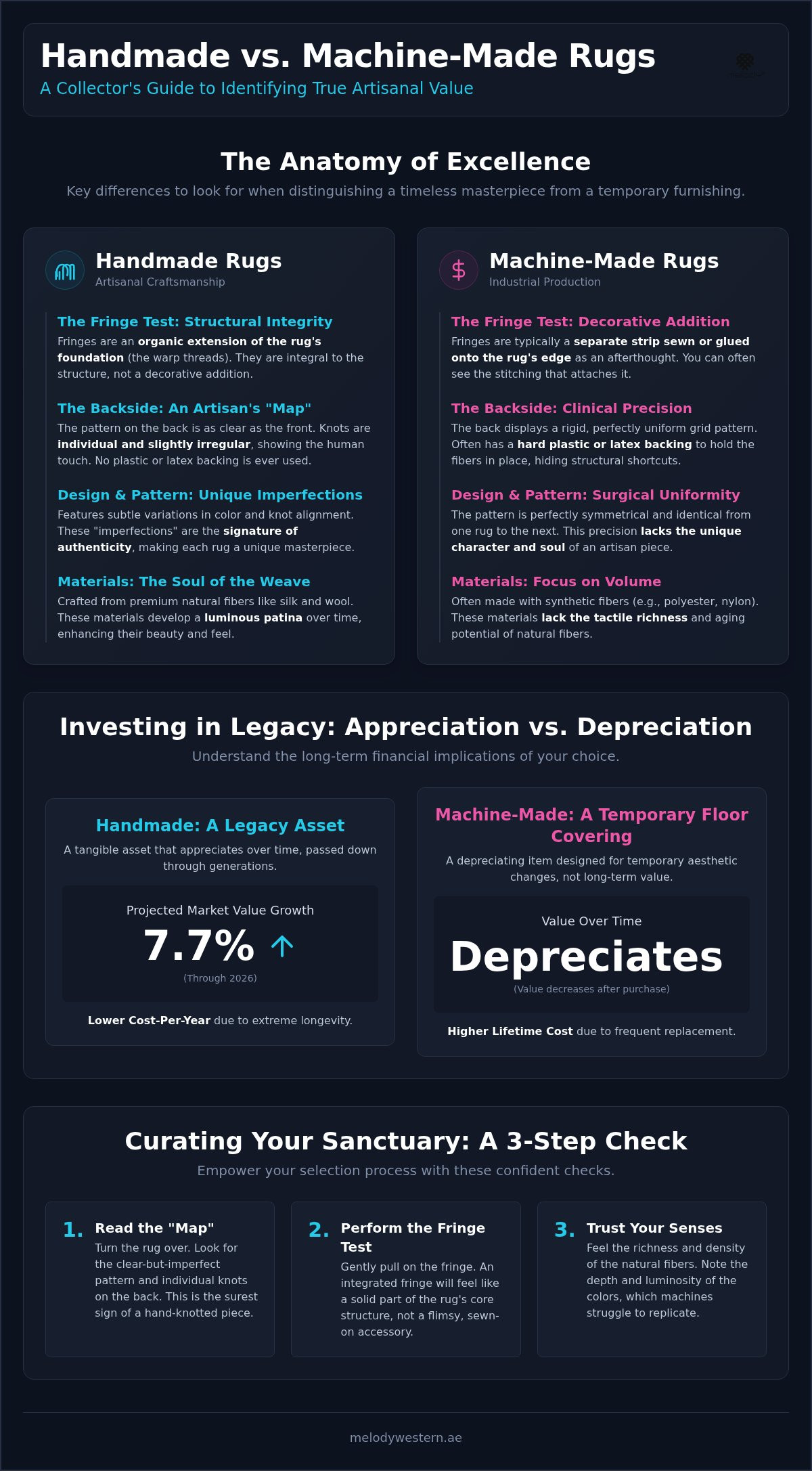
It's easy to feel overwhelmed by technical terms like warp, weft, and knot count, especially when seeking the luminous quality of authentic Persian silk. This guide empowers you to distinguish between the superficial perfection of industrial production and the enduring value of artisanal craftsmanship. You'll gain the confidence to identify authentic hand-knotted pieces and understand why these works of art are projected to see a 7.7% growth in market value through 2026. We'll explore how to evaluate materials and select a piece that serves as both a stunning visual anchor and a prudent investment in your lifestyle.
Key Takeaways
- Master the subtle art of identifying a handmade rug vs machine made by reading the "map" of the artisan’s hands visible on the underside of the weave.
- Learn the "Fringe Test" to differentiate between an integrated foundation that ensures structural integrity and a sewn-on decoration that lacks heritage.
- Understand the sensory and financial benefits of authentic Persian silk, which develops a luminous patina and appreciates as a tangible legacy asset.
- Discover why a higher initial investment in artisanal craftsmanship results in a lower cost-per-year than temporary, industrial floor coverings.
- Gain the confidence to select a piece that harmonizes with your sanctuary by evaluating master-artisan designs within your home’s unique light.
The Soul of the Weave: Defining Handmade and Machine-Made Artistry
Design is the silent language of the home. It speaks of taste, heritage, and the value we place on our surroundings. The fundamental distinction between a handmade rug vs machine made is not merely a technicality; it's a difference of spirit. One is a dialogue between human hands and natural fibers. The other is a cold execution of a digital file. True luxury resides in the human element. A handmade rug is a quiet labor of profound devotion, often requiring months or even years of concentrated effort by master artisans. Every square inch represents thousands of individual knots, each tied with a level of structural integrity that machines simply cannot replicate.
In contrast, the machine-made rug is a product of high-speed industrialism. These pieces are created on massive power looms that prioritize speed and volume over individual character. While they offer a certain surface-level symmetry, they lack the intrinsic strength found in traditional weaving. You'll often find the term "handmade" misused in modern retail markets across the UAE. Some brands apply the label to any item that involves a human operator, but this is a far cry from the master-artisan tradition. Authenticity is found in the loom, the knot, and the weaver’s intuition.
The Master Weaver’s Narrative
Every knot represents a deliberate choice. An artisan doesn't just follow a pattern; they interpret it. The Soul of the Weave is embedded in the cultural heritage of these motifs, passed down through generations of weaving families. Minor variations in shade or knot alignment aren't flaws. They're the signatures of authenticity. These subtle "imperfections" distinguish a legacy asset from a factory commodity. They ensure that your rug is a unique masterpiece, never to be exactly replicated in another sanctuary.
The Precision of the Power Loom
Machines prioritize uniformity. They produce rugs with surgical precision, yet they lack the structural depth of hand-bound fibers. A power loom rug might suffice for a temporary aesthetic change in a high-traffic commercial space. However, it will never possess the tactile richness or the long-term appreciation of a hand-knotted piece. Without the human touch, the materials don't have the same "soul." They feel static. They're furnishings, not investments. For the connoisseur, the choice is clear; only the hand-knotted piece offers the prestige and longevity required for a truly refined home.
The Anatomy of Excellence: How to Tell the Difference
To truly understand the distinction of a handmade rug vs machine made, you must look beyond the surface. A rug's beauty is skin deep, but its soul is found in its skeleton. The first point of inspection is always the fringe. In a hand-knotted masterpiece, the fringe is an organic extension of the rug's internal structure. These are the very foundation threads, known as the warp, left exposed at the ends. In contrast, machine-made pieces often feature a fringe that's merely a decorative strip sewn onto the edge as an afterthought. If you can see the stitch where the fringe meets the pile, it's a clear indicator of industrial production rather than artisanal devotion.
This structural honesty is part of what we call The Anatomy of Excellence. When you examine the back of a rug, you're reading a map of the artisan’s hands. You'll notice that the lines are not perfectly straight. A machine produces a grid of clinical, sterile precision. A human hand creates a rhythm that is consistent but never rigid. These slight deviations in symmetry are the hallmarks of a genuine investment. They tell a story of a creator who adjusted their tension knot by knot, responding to the natural variations of the silk or wool.
Reading the Reverse Side
Turn the piece over. An authentic hand-knotted rug will show the exact pattern and color of the front on its back with startling clarity. The knots will be individual and slightly uneven in size, proving they weren't programmed by a computer. You'll never find a plastic or latex coating on a true artisanal piece. Such backings are used in machine-tufted rugs to hide shortcuts. They lack the structural integrity of hand-tied knots. You should be able to clearly identify the vertical warp and horizontal weft threads, creating a dense, flexible fabric that breathes and ages gracefully.
The Overcast and Selvedge
The edges, or selvedges, provide the final clue to a rug's origin. In a handmade rug, the edges are wrapped by hand to secure the weft threads. This creates a slightly irregular, hand-stitched finish that is incredibly durable. Machine-made rugs use a process called surging, where a machine wraps the edge with perfect, uniform loops. This industrial finish often feels stiff. It lacks the graceful tension of hand-work. For those seeking a piece that truly resonates with the sanctuary of their home, exploring a collection of Hand Made Rugs in person allows you to feel these tactile distinctions firsthand. The weight and flexibility of a hand-bound edge are unmistakable signs of quality.
Material Integrity: The Luxury of Silk and Natural Fibers
The soul of a sanctuary resides in the tactile truths of its elements. When considering a handmade rug vs machine made, the material choice is where the most profound sensory distinctions emerge. Authentic Persian Silk Rugs possess a luminous brilliance that synthetic substitutes, often marketed as "art silk" or viscose, can never replicate. This brilliance isn't merely visual. It's found in the cool, liquid-like touch of the fibers against the skin, a necessary reprieve in the warmth of the Emirates. Authentic silk breathes. It allows air to circulate through the hand-tied knots, maintaining a temperature that feels perpetually inviting.
Natural fibers like master-grade wool and silk don't just endure; they evolve. Over decades, these organic materials absorb the history of a home, developing a soft, sophisticated patina that enhances their depth. Machine-made synthetic fibers, conversely, are born at their peak and begin a steady decline from the moment they're unrolled. They lack the resilience to age gracefully; they eventually become brittle and lose the vibrancy that once defined them. For the discerning collector, the "patina" of a hand-knotted piece is a badge of heritage, whereas the wear on a synthetic carpet is simply a sign of expiration.
The Resilience of Organic Materials
Master-grade wool contains natural lanolin, a protective wax that acts as a built-in shield against spills and stains. This organic defense is why a hand-knotted wool rug can withstand generations of life while maintaining its luster. Hand-spun silk threads offer incredible tensile strength, allowing for the intricate, high-density knotting that defines master-artisan work. When paired with natural vegetable dyes, these materials maintain a depth of color that shifts beautifully under different lighting conditions, a quality that flat, chemical dyes cannot achieve.
The Limitations of Synthetic Weaves
Machine-made rugs often rely on petroleum-based fibers like polyester and nylon. These materials act as heat traps, which can make a room feel stifling rather than serene. Beyond the climate discomfort, synthetic weaves are prone to "shedding" and flattening, as the mechanical fibers lack the structural memory of natural wool or silk. From an environmental perspective, these disposable floor coverings contribute to a cycle of waste. They're temporary furnishings that lack the soul and sustainability of a piece crafted by human hands from the earth's finest offerings.
Investing in Legacy: Appreciation vs. Depreciation
True luxury is measured by time. While the upfront cost of a handmade rug vs machine made can seem substantial, it's the only path to long-term value. An industrial rug is a consumable. It's designed for the landfill. From the moment it's unrolled in a luxurious setting, it loses nearly 90% of its resale value. It's a temporary fix for an empty space. A master-knotted piece, however, is a tangible asset. It's floor art. Like a fine timepiece or a rare painting, it commands respect in the secondary market because its quality is undeniable and its supply is limited. In the world of high-end interiors, the distinction between a handmade rug vs machine made is the difference between a fleeting trend and a lasting legacy.
A shift in perspective reveals the true economy of excellence. Consider the lifespan of your investment. A machine-produced carpet rarely survives five years of daily life before the fibers flatten or the backing fails. A hand-knotted silk or wool piece easily endures fifty years or more. When you divide the initial investment by decades of service, the master-artisan piece often proves more affordable than a series of cheap replacements. Maintenance is minimal. Natural lanolin in wool and the inherent strength of silk resist the passage of time. These pieces don't just sit in your home. They grow with it. Many collectors find that their antique pieces eventually appreciate. They become heirlooms that hold or exceed their original purchase price.
Calculating the Cost-Per-Year of Luxury
The mathematics of quality favor the patient collector. High-quality silk and wool require very little intervention to maintain their luster, unlike synthetic fibers that trap dirt and require frequent chemical treatments. Because these pieces are crafted with structural integrity, they retain their form even under heavy use. This durability ensures that the piece remains an asset rather than a liability. Master-artisan pieces hold their value among collectors because they represent a finite resource of human skill that's becoming increasingly rare.
The Heritage Factor
There's a deep pride in owning a piece that is truly one-of-a-kind. When you choose a Custom Rug, you're not just buying decor. You're commissioning a chapter of your home's story. Every knot represents a day in the life of an artisan. It's a connection to a weaving tradition that stretches back centuries. This human narrative adds a layer of prestige that a machine can't simulate. You're also making an ethical choice. You support the survival of ancient craft communities. Your sanctuary becomes a gallery of personal expression. It's anchored by a piece that carries the weight of history and the promise of a future legacy.
Curating Your Sanctuary: The Path to the Perfect Purchase
The decision between a handmade rug vs machine made is ultimately a choice of how you wish to inhabit your space. Selecting the final anchor for your sanctuary requires more than a discerning eye; it demands an understanding of how a piece interacts with your home’s unique architectural soul. While industrial carpets offer a temporary convenience, they lack the ability to transform a room into a gallery of personal expression. A master-artisan rug, however, adapts to its environment. It responds to the shifting desert light and the specific shadows of your interior, becoming a living participant in your daily life rather than a static floor covering.
Melody Carpet operates on a philosophy that treats every acquisition as a significant cultural investment. We believe that the search for the perfect weave shouldn't be confined to a showroom. By bringing the gallery experience directly to your doorstep across the UAE, we ensure that the human element of our craftsmanship meets the intimate reality of your home. This curated approach allows you to witness the profound distinctions of a handmade rug vs machine made within the very walls the piece is intended to grace.
Matching Style to Architecture
Architecture dictates the rhythm of a room. For a formal majlis, a Classic Carpet provides a sense of gravity and historical prestige that echoes traditional Emirati hospitality. The intricate motifs and deep palettes of these pieces anchor large spaces with an air of established authority. Conversely, minimalist contemporary villas in neighborhoods like Jumeirah or Saadiyat Island often benefit from the softened textures of a Modern Carpet. These designs use master-artisan techniques to create subtle, abstract landscapes that complement clean lines. For grand hallways or transitional spaces, a Frame Rug serves as vertical art, drawing the eye upward and celebrating the weaver's skill as a focal point of the home’s narrative.
The Luxury Home Trial Experience
You should never commit to a high-end investment without seeing it breathe in your own light. The luminous glow of Persian Silk Rugs changes dramatically under the specific warmth of your chandeliers compared to the sterile lighting of a retail store. Our complimentary home trial experience is designed to eliminate uncertainty. It allows you to feel the tactile density of the knots and observe how the silk’s sheen shifts as you move through the room. This process grants you the confidence of knowing a piece perfectly fits your sanctuary before a final commitment is made. It’s a methodical, graceful way to ensure that your selection isn't just a purchase, but a legacy asset that will be cherished for generations.
Securing Your Legacy in Every Thread
A sanctuary is defined by the quality of the objects it holds. By understanding the profound distinctions of a handmade rug vs machine made, you move beyond mere decoration into the realm of true curation. You've learned to read the map of the artisan's hands on the reverse side and to value the organic resilience of master-grade silk. These aren't just floor coverings; they're investments in heritage that appreciate as they age. Every knot tied by hand is a testament to a tradition that refuses to be rushed by industrialism.
The journey toward your perfect piece should be as refined as the rug itself. Whether you desire the timeless prestige of master-artisan Persian silk or require a bespoke custom design for a unique architectural space, we're here to guide you. Experience the elegance of our handmade collection with a complimentary Home Trial and take advantage of our free national delivery across the UAE. It's an invitation to see how true craftsmanship responds to the unique light and spirit of your home.
It's time to transform your home into a private gallery of expression. Trust in the human element and select a piece that will serve as a beautiful anchor for your sanctuary today and a cherished heirloom for tomorrow.
Refining Your Knowledge: Frequently Asked Questions
How can I tell if a rug is handmade or machine-made just by looking at the back?
The reverse side of an authentic piece reveals individual, slightly irregular knots that prove the human element of the weave. In a handmade rug vs machine made comparison, the artisanal back shows the pattern and color with startling clarity, mirroring the front. Machine-made carpets feature a sterile, perfectly uniform grid and often hide their construction behind a stiff plastic or latex backing that lacks flexibility and breathability.
Is a handmade rug actually worth the significantly higher price?
A handmade rug is a legacy asset that appreciates over time, making it a far more prudent investment than a disposable industrial furnishing. While the initial cost is higher, the cost-per-year is lower because these pieces can endure for fifty years or more with proper care. You're investing in master-artisan skill and premium natural materials that maintain their prestige and value in the global collector market.
Do handmade rugs have imperfections that I should be worried about?
Slight variations in knot alignment or subtle shifts in dye shades are hallmarks of authenticity, not flaws. These nuances prove that the piece was crafted by a human hand using natural materials and traditional vegetable dyes. Such characteristics distinguish your rug from the clinical, soul-less uniformity of factory production, adding a unique narrative and character to your sanctuary.
Can I use a handmade silk rug in high-traffic areas of my home?
Authentic silk possesses incredible tensile strength, but its luminous pile is best reserved for formal spaces like a majlis or a private gallery. While durable, silk is sensitive to heavy friction and moisture, which can dull its natural brilliance over time. For high-traffic family zones, a blend of master-grade wool and silk provides the necessary resilience while maintaining an elevated aesthetic.
How long does it typically take to create a custom handmade rug?
Creating a bespoke master-artisan piece is a methodical process that typically spans several months to over a year. The timeline depends entirely on the dimensions and the intricacy of the knot density required for the design. This deliberate pace ensures that every knot is tied with absolute precision, resulting in a one-of-a-kind masterpiece that fits your architectural space perfectly.
What is the best way to clean a handmade Persian silk carpet without damaging it?
Professional dry extraction by a specialist is the only recommended way to maintain the integrity of delicate silk fibers. You should never use steam or harsh household chemicals, as heat and moisture can cause the natural dyes to migrate and damage the silk's luster. For daily care, gentle vacuuming in the direction of the pile is sufficient to keep your investment pristine.
Are machine-made rugs always lower quality than handmade ones?
Machine-made rugs serve a functional purpose for temporary decor, but they cannot compete with the structural soul and longevity of a hand-knotted piece. They rely on synthetic, petroleum-based fibers and chemical adhesives that begin to degrade the moment they're unrolled. In the world of high-end interiors, the industrial option is a temporary commodity, whereas the handmade piece is a permanent work of art.
Why does the fringe on a handmade rug look different from a machine-made one?
The fringe on an artisanal rug is a structural extension of the internal warp threads, making it an organic part of the foundation. In contrast, a machine-made fringe is merely a decorative strip sewn or glued onto the edge after the weaving is complete. If you can see a stitch or tape where the fringe meets the pile, it's a clear sign of industrial production rather than hand-work.
Leave a comment